Tuesday, February 25, 2014

Cabela's XPG line

I really like Cabela's, and for a variety of reasons, I'd rather shop there for my outdoor stuff than REI, or Dicks, or some other Joe Blow sporting goods store.  However, Cabela's is very focused on hunting and fishing, and where I'm looking for technical backpacking and hiking gear, they haven't always been the best choice.

I just got a new Cabela's catalog in the mail a week or so ago, though, and I can see that they've made an impressive foray into that experience as well with their XPG--Extreme Performance Gear--line.  The catalog I got was men's clothing, and that's where the majority of the new stuff seems to be, but it looks like there's been an XPG camping gear selection out there for some time.

Some of the stuff seems pretty good--$140 Gore-tex, lightweight hikers, for example, is as good as any on the market.  $300+ tents and sleeping bags, on the other hand, don't impress me as a great deal.

Still, there's some great looking things to be mined there.  If I had that corporate sponsor I mentioned a few posts ago, I'd go spend some $4000 overnight on stuff, and I'd basically wear Cabela's outdoor clothing as my everyday uniform.

Tuesday, February 18, 2014

This summer's backpacking trip...

My plans for the year continue to be in a bit of flux.  I have a fair bit of my vacation already "spoken for," including a cruise with the family.  I might go on a nearly two-week spread of day-hikes in the West with my family, if things work out.  If not, I'll go on at least a week or so backpacking trip by myself.  I've posted in the past about my day-hiking options.  My backpacking options are, I believe, as follows:
  • The Teton Crest Trail.  With maybe a Shoal Falls loop as a warm-up in the nearby Gros Ventre wilderness.  This would give me a change to acclimate to the altitude before tackling the Tetons.  My biggest concern here is with bear canisters, and permits.
  • The High Uintas.  I'd like to hit up King's Peak, and maybe Naturalist Basin further west.  Not sure yet how I'd link them, but I'd probably do them as two short trips, interrupted by a car ride to a new trailhead.  If I do this, I'd likely warm-up with the summit of Timpanogos first.
  • If permits for the Teton Crest trail are scarce, I could do something similar in the nearby Wind Rivers.  Warm-up with a 3 day Gros Ventre appetizer, and then do two smaller trips into the Winds--one to famous Titcomb Basin and one to equally famous Cirque of the Towers.  I'd love to actually link the two, but realistically I probably won't this time out.  I'm still a bit rusty to take on something quite that ambitious.
  • Maroon Bells-Snowmass Wilderness loop hike.  Just to give Colorado a shout-out, and it is one of my short-list wanna hikes.  Permits and crowds, again, might be an issue.
  • There's also the possibility of some autumn backpacking.  If I do this, I'd look at the Art Loeb Trail in North Carolina in October.  Or possibly a late October or early November Grand Canyon backpacking trip.

Monday, February 17, 2014

Hiking abroad

I've said before, and I'll reiterate now--I love the American landscapes.  Especially the American West.  I can get all the hiking I'll ever need in the Rockies, the Sierras, the Cascades, the Great Basin, the Appalachians, etc.  Heck, I can probably get all the hiking I ever need in Colorado alone (although frankly, I'm more inclined to look towards Wyoming and Montana for the Rockies, and Utah and Arizona for the Colorado Plateau experience.)  I'm almost jingoistic about preferring the American West, with a nod towards the American east as a nice secondary location.  But there is one major problem with this: the season is too short.

For mountains in the Rockies, the Sierras, or the Cascades, the season is (basically) July, August and September.  On low snow years, you can incorporate June, especially if you stick to lower elevations.  Because I don't do skiing--cross-country, Nordic, or otherwise, and I don't really like hiking in serious snow, my season is fairly short.

I can get desert hikes in on the "shoulder" seasons.  The best time to go to Canyonlands or the Grand Canyon is actually the spring and the fall.  The lower elevation mountains of the Appalachians, like the Smokies and the rest of the Blue Ridge, are arguably better in October than any other time, whereas the more northerly parts of the Appalachians, and the higher elevation Rockies, Cascades and Sierras are extremely iffy in October, if they're available at all.  But that only extends my hiking season to, oh, about seven months.  Maybe eight if I'm really pushing it.

During the "dead" of winter, I have slim options in the US.  There's some great hikes in Hawaii and American Samoa, for instance (although they're extremely hard to get to, relative to the Rockies).  Big Bend National Park, I can attest, is lovely in February (and presumably much of the rest of the winter) if you don't mind extremely arid hiking.  The same could be true of Guadalupe Mountains National Park, Organ Pipe Cactus National Monument, Saguaro National Park, and parts of Death Valley.  But what I really want is mountains, and to get those in the "off season", you have to flip over, find yourself in the southern hemisphere where the seasons are reversed, and try it that way.

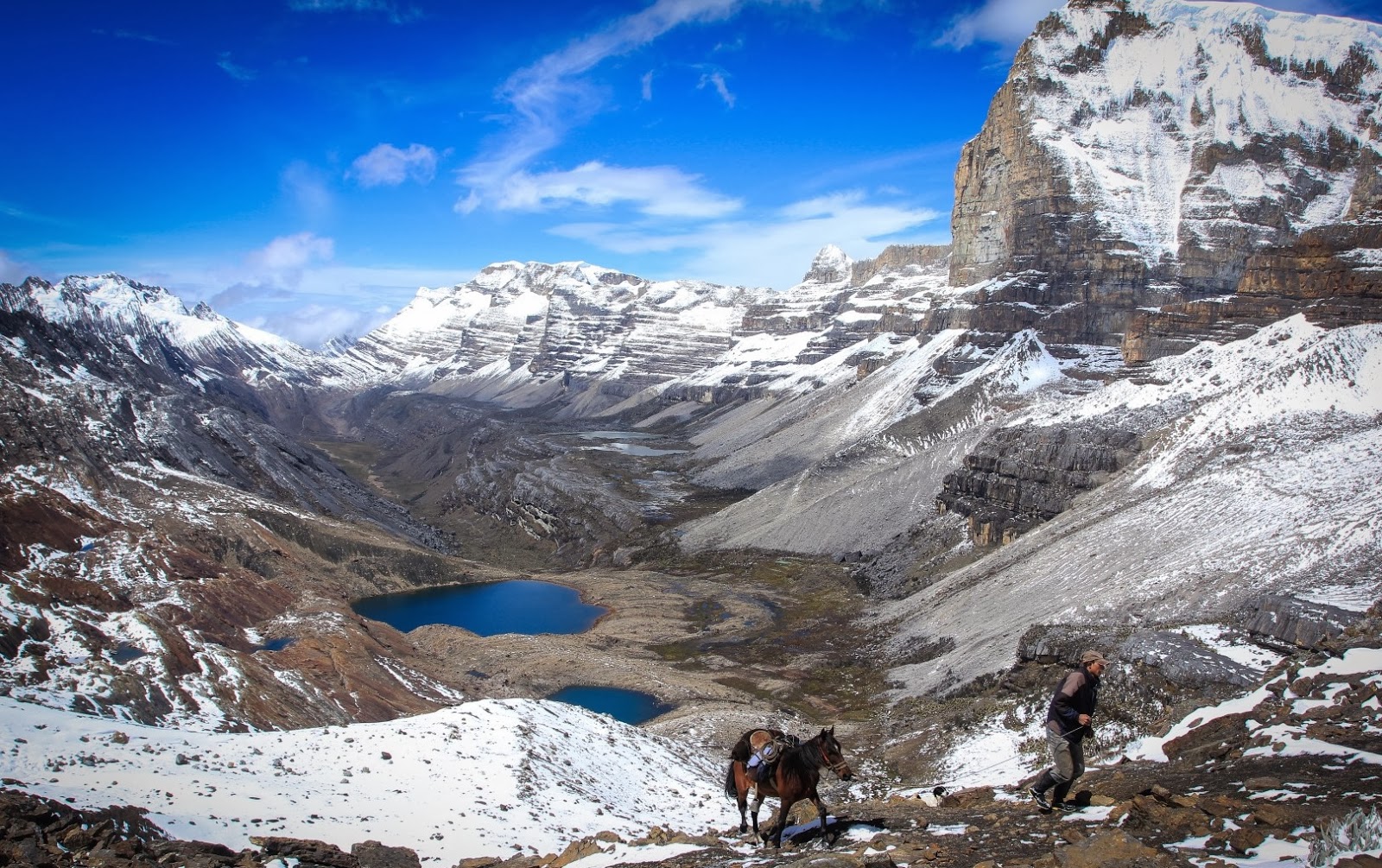
Oddly, there are a few less options than you'd maybe think by doing this, since the percentage of the earth covered by land in the southern hemisphere is dramatically less than in the northern hemisphere.  But your best options probably include the Southern Alps in New Zealand (famous as the locations used in the Lord of the Rings and Hobbit movies) or portions of the Andes in South America.  New Zealand has got to be the better of the two options, given that it is political much more stable than many of the countries of South America, and you don't have to learn another language to get by (as it happens, I already speak Spanish, and I learned it in Argentina, so I'm OK on that front.)  I've been extremely impressed, however, with photography that I've seen from hikers in the Andes, particularly the Patagonian Andes.  When I was in Argentina, the Bariloche region was often billed as a "little Switzerland" in terms of settlement patterns, architecture, chocolate, and... of course.. scenery.  I hadn't yet heard of some of the stunning vistas of the even more southerly Patagonian Andes--Torres del Paine, or Monte Fitz Roy, or Cerro Castillo, for instance.

I'd love to fill my Jauuary and Feburary itineraries with backpacking trips into the Patagonian Andes, and then come home to fill my July and August (and September) itineraries with the Rockies, the Cascades and the Sierras.  Heck, Argentina even has a reverse Colorado Plateau desert systems in Talampaya National Park and Ischigualasto Provincial Park to help round out my shoulder seasons.  If I can find a way to do this, I can hike at any time of the year in a stunning wilderness setting.

Here's some images I've grabbed over time on the internet of Andes hiking opportunities:


Now; does anyone know how I can go about getting a corporate sponsor to keep me hiking for about four months of the year, and support me for the remaining eight while I plan and equip myself?

Thursday, February 13, 2014

Hiking pants, redux

I recently bought two pairs of "hiking pants."  Specifically, they are Cabela's brand "Lookout Peak Trail Pants."  They normally retail for $55 (about par for the course for hiking pants) but I kept my eyes open for a decent sale and bought they just under $30 each.  I've even seen them as low as $20 several months ago.  Cabelas.com is weird in that they frequently have short-lived sales that come and go.  I had some Cabela's gift cards to spend, and had been waiting for almost two months for a decent price before I hopped.

Be that as it may, what makes a good hiking pant, and why did I buy these?  Honestly, I bought them because I found them at just under $30.  I would have bought Railriders, or something by REI or Timberland or Patagonia or Columbia... or anyone else if they were the kind of trail pants I wanted at that same price.  And I had a gift card I could use.  Although I do admit that I prefer buying Cabela's when I can, and these pants are everything I want.  Namely:
  • 100% nylon shell and 100% polyester mesh (for pockets and such.)  Good hiking pants need to be made of a material that is lightweight, sufficiently rugged, and quick drying.  There is of course more than one material or blend of material that fits this bill, but this particular combination does the trick.
  • Loose enough to be comfortable to wear and move around in, but not so baggy that they constantly rub and snag on stuff as your walking.  On well manicured, wide trails, this may be less of an issue, but since I prefer to think that I'd go into the backcountry on trails that are narrow, possibly overgrown in meadows and whatnot, and otherwise of occasionally dubious condition, I want them to be loose, but slightly tapered.  Gusseted crotch for even better mobility.  Fits the bill.
  • By the same token, I don't want or care for shorts or zip-off pants.  Lots of hikers hike in shorts.  I've done it myself.  It's a good way to get your legs all scratched up, bitten by bugs, or at least extremely dirty.  Worse case, I've had my shoes and socks completely covered in prickly seed pods.  Smooth, long pants would have completely protected me.  The zip-off feature ends up being something that you pay extra for, but which I don't want.
  • In that case, of course, I want pants to be light enough that I'm not feeling really hot on summer days hiking.  These fit the bill.  In fact, since they keep the sun off of my skin, they may be better than shorts.  Although you don't get a lot of sunburn on your legs from walking anyway.
  • Since they're light, I need to be able to comfortably fit a base-layer underneath them when it isn't hot, which is anytime in the mountains not in the summer, and heck, you never even really know about the summer.  Last night, I had to get into the power distribution box of my car.  With a pair of these, and a base-layer bottom, I was kneeling in the snow working on it for about an hour, and felt comfortable.  Ka-ching!  They work.
  • A few pants come with a very expensive option: bug-resistance.  This seems like a silly frill to me.  Not that it's not a good idea, but paying all kinds of money for it is.  For $10 at Wal-Mart, I can buy a spray bottle of Permethrin, spray all of my clothes, my hat, my backpack, my sleeping bag, and maybe even my tent (or at least part of it) before it's empty and get months worth of bug-resistance.  Supplement that just a bit with a small container of bug-spray, and I should be good to go for an entire season of hiking, for just $10.  And a lot better to go than I would be with just bug-proof pants.
In all, I'm quite happy with this purchase.  This is way better than hiking in jeans or canvas cargos--or at least, I'm managed to avoid potential issues that those pants would carry with them.  And frankly, I didn't have to spend really any more money than I would have for those.

Wednesday, December 18, 2013

Long Hikes

I've long been fascinated by the concept of the "long hike."  The original such concept in the U.S. is, of course, the Appalachian Trail, which stretches from Springer Mountain in northern Georgia to Katahdin in Baxter State Park, Maine.  My interest has inevitably been drawn to the two western, and more recent, accomplices in this category: the Pacific Crest Trail, which goes from the Mexican border near Campo, California, to the edge of Manning Provincial Park, British Columbia (technically, of course, the trail ends at the border) and the Continental Divide Trail, which runs from the Mexican border at one of three southern termini in the New Mexican bootheel, to a northern terminus on the border of Glacier National Park and Waterton Lakes National Park (in Canada.)  The lengths of these trails is tremendous: the Appalachian Trail is about 2,200 miles of walking (not counting diversions to resupply or see scenic highlights off-trail, etc.) while the PCT is about 500 miles longer than that, and the CTD is about 400-500 miles longer still. 

As much as I am fascinated by this concept, I'm not really likely to ever hike one of these trails in its entirety, especially not as a single-season "thru-hike."  However, the trails have inspired me to consider rather lengthier backpacking trips, with possible resupply points and up to a few weeks off, to see certain highlights.  I'd love to hike the John Muir Trail, for example (220 or so miles), and the entire Sierra Nevada portion of the PCT (even longer, although picking specific start and end-points might be a bit tricky.)  I'd love to do a White Mountains traverse of a portion of the northern AT, including Franconia Ridge and the Presidentials.  I wouldn't mind doing the 100 Mile Wilderness portion of the AT as well. 

I was a bit disappointed, however, to see that the CDT takes a big westward "bite" just south of Helena and Butte, Montana, to ramble along the Idaho/Montana border, before turning sharply eastward through Yellowstone National Park and the Teton Wilderness to then traverse the Wind River Range.  This is sensible, of course, since the goal of the trail is to march as near as possible to the actual continental divide, but it misses some of the most beautiful scenery in the northern US Rockies to do so.  I'd love to traverse the Wind Rivers, but I'd also love to link such a traverse with a traverse of the Beartooths and the Absarokas.  To traverse, north to south, the Beartooth range in the Absaroka-Beartooth wilderness, starting near Livingstone, Montana.  Get a friendly resupply somehow (maybe my wife waiting in the car, I suppose) on the Beartooth Highway, before plunging south to traverse north to south the North Absaroka Wilderness with another friendly resupply nearly a week later on the Greybull Highway, before plunging southward again to travese the Washakie and Teton wilderness boundary.

One more friendly resupply, and I do a Wind Rivers traverse, ending this epic, month-long (at least!) hike at the Bed & Breakfast in Atlantic City, Wyoming (an ambitious name, given that the latest census has the population of the place at 37.)  The southern portion of this hike; mostly the entire Wind Rivers traverse, would be the CDT (plus a few side-trips to see Titcomb Basin and Cirque of the Towers.  It'd be ridiculous to go there and miss those spots.)  The traverse of the Beartooth is on existing trails, with a route that's already mapped out (again with a few scenic side-trips, no doubt.)  I'm not aware of any traverse of the Absaroka range that are done routinely enough to be named, labeled and widely available to the knowledge of hikers; I'd probably have to stitch such a traverse together myself from existing trails, and if necessary, do some cross-country bridging sections.

I'd also love to hike much of the area north of here; a traverse of Glacier and the Bob.  But I'm a bit ambivalent about the connection between the Bob and the Beartooths, and I don't want to create a route that takes me more than about a month or so to complete, so a Glacier/Bob Marshall traverse will have to remain a separate trip.  I'm also quite anxious to hike much of the Colorado Rockies, but the Great Divide Basin in southern Wyoming that separates the scenic Wind Rivers from equally scenic northern Colorado is a wasteland in terms of anything I'm curious to hike.


Getting gear

Because my long backpacking trips that I yearn to do are not exactly imminent (it's the dead of winter, for once thing, and the majority of my vacation time for 2014 is already "spoken for" on a number of trips--which will include some nice dayhiking with the family on a lengthy trip, but no several nights in the backcountry backpacking trips, sadly.)  At the soonest, I'm looking at late winter 2015 for a Big Bend or Guadalupe Mountains trip, or spring 2015 Grand Canyon or southern Utah trip, or late summer 2015 anywhere in the classic mountains.  This means that I'm not exactly running out to finish off my shopping list of backpacking gear, and picking up all of the things that I still need.

This doesn't mean that I'm not making an inventory and "wish list" of specific items I want to get and have ready for when that time comes, though. 

However, I'm finding that making a list that will last long enough for me to actually buy the gear is more difficult than I thought.  I've had to change the backpack on my list several times--sometimes because as I've done more research, I've found other models that I want, but surprisingly because one of my perenniel top contenders seems to have removed itself from common availability.  I can still get it if I really want it, but only from one of three outlets, where it used to be readily available everywhere.

I later picked up a new favorite, after it got a really high recommendation from Backpacker Magazine, and it promptly became unavailble other than through special order.  Did demand exceed supply?  Dunno.

I suppose it's not a big deal, until I'm ready to actually go pick up my backpack, but it's a little frustrating that I can't plan what backpack that will be unless I just go buy it now. 

Sunday, December 8, 2013

Newbie mistakes

http://www.backpacker.com/prof_hike_beginner_mistakes/skills/14472

A friend of mine shared this link.  I commented on one thing that caught my attention right away.  Later, I thought of another.  Later still, I was annoyed by another.  Finally, I decided that I needed to "rebut" the article point by point.  Well, not really--I agree with about half of what he says.  The other half is baloney, though.  Or at least, it's propaganda rather than fact, even when he has a point.

1) Wearing denim.  Denim is a soft, yet durable fabric.  It's considered bad news for hiking because it absorbs water and doesn't dry quickly.  You can get some serious chafing if you hike in wet jeans.  It can even freeze solid.

However, most people don't go hiking in conditions where any of that (other than maybe getting wet) is very likely.  I'd prefer not to hike in denim.  But I hiked for years in blue jeans as a teenager, and the notion that you can't do it without dying is patently absurd.  In summer hikes, or desert hikes--where I do a lot of my winter, spring and fall hiking when I can, there's no problem at all in hiking in denim.  For day hikes, where you know that you're unlikely to get caught in an unexpected rainstorm, there's no problem at all hiking in denim.  Denim's dangers are highly over-rated.

I still wouldn't take them on a backpacking trip, though.  Especially not one in the Rockies or the Cascades, where getting rained on at least a little bit, is almost a certainty.

2) Why are specialty outdoor stores more trustworthy?  They're certainly more expensive.  There's a few things that I really wouldn't want to buy at Wal-Mart (my boots, for example) but otherwise, I've found that plenty of what they sell is perfectly fine.  In fact, plenty of what they sell is the exact same stuff that you can get at department stores.  Sure, it's not necessarily the same as what you can get at REI, but let's face it--a lot of that stuff is over-priced.  You're paying more for the brand name than anything else.  Does it surprise you that this is an article written for Backpacker magazine, a publication who's major revenue source is advertising from specialty gear manufacturers and retailers?  Keep that in mind as you read this point.

3) Another often overpriced element of hiking.  I've done lots of hikes in Nat Parks with the Nat Park official map, for instance.  The Trails Illustrated or the USGS topos are plenty nice, but you need to know your area and what you're doing.  If you're going deep in the backcountry, by all means, have them.  If you're sticking to well-established paths, they're expensive overkill.

4) I agree with this one, only based on the notion that even back in the 80s, before this was trendy, I was taking stuff out of my pack that I wasn't using and couldn't really see myself as very likely to use.  A bandage for wrapping up a twisted ankle or binding a major cut is good.  Some smaller bandages.  Some pepto in case you eat something that doesn't agree with you.  Some ibuprofen and acetaminophen for the inevitable headaches when you don't sleep well enough or don't get enough to drink.  Or just for muscle soreness.  That's mostly all you'll ever need.

5) I agree with this one.  Don't mess around with lightning.

6) I sorta agree with this one: before you start thrifting your back of stuff, you need to have enough experience to know what you can comfortably live without and what not.  But everyone should give some serious thought to weight reduction.  It just makes hiking so much more enjoyable.  Ultralight itself is almost the fetishization of lightweight hiking, but a lot of its principles should be researched and used by even a first-time hiker.

7) If you get boots with a relatively soft (i.e., common) nylon and leather combination upper, and that fit you properly, and you have the proper hiking socks (a liner and merino wool is best) then you can absolutely do this.  This bit of wisdom is based on the old days with stiff, full-grain leather uppers for high-top combat boots style hiking boots were common.  Yeah, bad idea to go on a long trip with those straight out of the box.  But most boots will do you just fine, as long as you--again--make sure that they fit properly.

8) Newbie mistake, or just common sense?  I can see the same problem being applied to other endeavors.  Newbies probably are poorer at estimating how far they can walk in an hour, though--I'm sure.

9) I agree with this one.  Check the forecast before you go; if you see something really ominous, rethink your plan.  Otherwise, make sure at least that you're prepared for it.  Deep backcountry forecasts, especially if you're checking before a several days-long trip, are always going to be iffy at best anyway.

10) Leave No Trace is nice. It's important.  Everyone should learn and use its principles. It's also gotten a bit out of hand.  There's no way in the world I'm packing out toilet paper.  This isn't a newbie mistake, it's a change in paradigm as Left Coast hippies have taken over the hobby. Calling this a newbie mistake was a political statement, not actually a useful warning.